


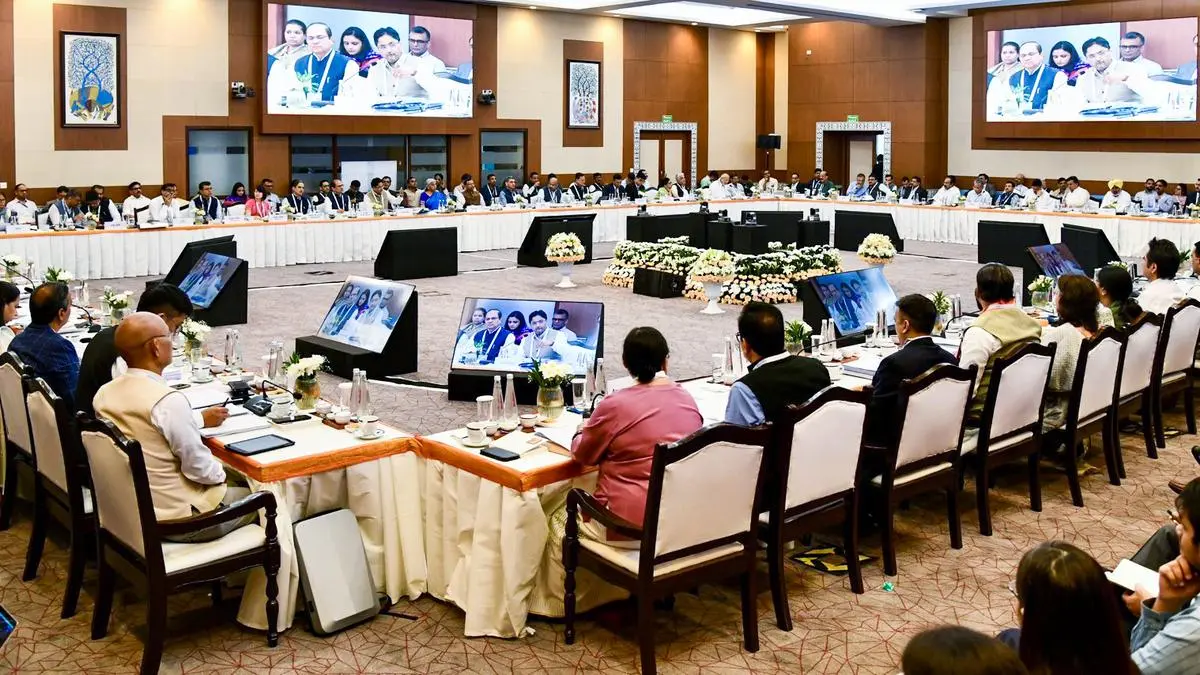
Finance Minister Nirmala Sitharaman with CII President Rajiv Memani during CII Global Capability Centres (GCCs) Summit, in New Delhi, on Monday
| Photo Credit:
PTI
Gross value addition (GVA) from global capability centres (GCC) could touch up to $200 billon by 2030, Finance Minister Nirmala Sitharaman said on Monday. The FM also expects a nearly five times increase in global roles within Indian GCCs.
Addressing a GCC summit organised by CII here, the FM said on an average, one new GCC per week was set up in 2024. Nearly half of Fortune 500 companies have set up their GCCs in India. GCCs employ nearly 2.16 million professionals in India, having grown at a CAGR of 11 per cent over the last 5 years. It is expected to reach 2.8 million by 2030.
“India’s GCC sector contributes $68 billion as direct gross value addition (GVA), i.e. around 1.6 per cent of the national GDP. By 2030, the gross value addition from GCCs could potentially range between $150 billion and $200 billion.” she said.
Setup rate
Further, the setup rate of engineering research & development GCCs has grown 1.3 times faster than the overall GCC setup over the last 5 years, indicating a clear shift towards high-value-added work in India. She highlighted that engaging Indian talent is more cost-effective as compared to other countries. It is estimated that it costs 30-50 per cent less than the US, UK and Australia. Over the past decade, India’s GCC ecosystem has matured significantly, moving beyond execution to become centres of strategic leadership and transformation.
Many GCCs now house high-end roles, including product managers, architects, data scientists and global function heads. A recent survey found that over 35 per cent of transformation hubs in India report a strong presence of architects, demonstrating the growing complexity and global ownership of tech mandates. “Global roles within Indian GCCs are expected to increase from 6,500 today to over 30,000 by 2030, supported by robust in-house training programs that nurture global-ready leadership,” she said.
On talent pool
The Minister emphasised that India’s unique strength lies in its immense talent pool, accounting for 28 per cent of the global Science, Technology, Engineering, and Mathematics (STEM) workforce and 23 per cent of the global software engineering talent. Over 32 per cent of global GCC talent is currently based in India. In the last decade, 7 new IITs and 16 new IIITs have been opened across the country. India has among the highest proportion of female STEM graduates, at 42.7 per cent. “It is important because there is approximately 35 per cent female participation in GCC workforce,” she said.
Economic Affairs Secretary Anuradha Thakur said India needs to streamline policies at national level to make the country a hub for GCCs. “Even now GCCs are focused on particular States so we need to study what those states did earlier, whether it was Karnataka, Tamil Nadu, Telangana. We know those states have specific policies both on physical infrastructure and digital infrastructure, they also have certain regulatory policy initiatives which have helped GCCs there and grow further. Whether we need to disturb that, or add more is something that we need to do today, perhaps a bit of both,” Thakur said.
More Like This

Published on July 14, 2025






























































































































































































Leave a Reply